Scope ________________________________________________________TOP
PAGE__
Obsolescent electronic
parts are causing more and more difficulties in managing maintenance of major
electronics systems of the industrial world. A common way of keeping old infrastructures
alive is to source and stock old parts which more often don't show any reliability
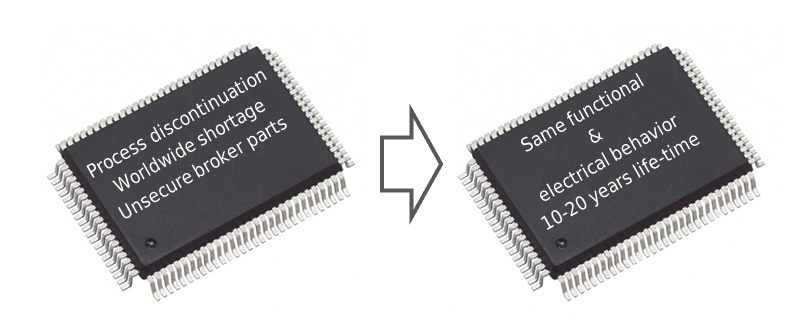
guaranties. ID MOS offers multiple solutions to replace obsolete components
by using a cloning method, adapted to quantities and technologies. ASIC and
FPGA programs enable to replace old analogue, digital or mixed-signal ICs
with the guaranty of equivalence and permanence with designs on reliable and
up-to-date semiconductors processes.
Specificity
of cloning a circuit: Unlike standard design methodology, cloning
takes into account existing application facts which are very seldom likely
to be modified. As such, ID MOS offers application-oriented IC designs, taking
into consideration the circuit environment and interactions within existing
old electronic boards. Finally, ID MOS cloning programs analyze specificities
and behaviors of older silicon process in order to technologically adapt the
new device. Then the cloned part interfaces identically with the original
board components.
Solutions _____________________________________________________TOP
PAGE__
ASIC programs
For mixed signal or analogue products, the cloning program can reach unexpected
performances in the design of an IC's identical part. Thanks to open possibilities
of full-custom ASICs, products are re-designed with a special care about technology
behaviors and interaction. It is is THE solution to get your circuit its new
identical twin.
FPGA programs
For pure digital products. This cloning program offers fast re-design of old
microcntrollers and various digital components. Regardless of technology matching,
FPGA-based cloning brings flexible and reactive solution to obsolescing issues.
IC cloning Methodology__________________________________________TOP
PAGE__
ID MOS methodology
covers a full scope of domains to explore in order to ensure that the cloned
part will identically match the original application.
 |
1. Architecture
study
Bibliography:
Gather all exsiting documents or evidences which can bring additional
elements to the standard products datasheet.
Application
study: Focus on the application architecture in order to detect specific
elements such as off-spec design features, peculiar component use, special
architecture implementations .
Technology
study: Based on the original component, describes and characterize the
specificities of the older technology in order to reproduce identical
interfacing and behavior with board and peripheral electronics parts.
2. Design
and prototyping phase
Standard circuit design and prototyping; including spec-based functional
features and architecture analysis outputs items.
3. Post-validation
design and foundry fabrication |
|